
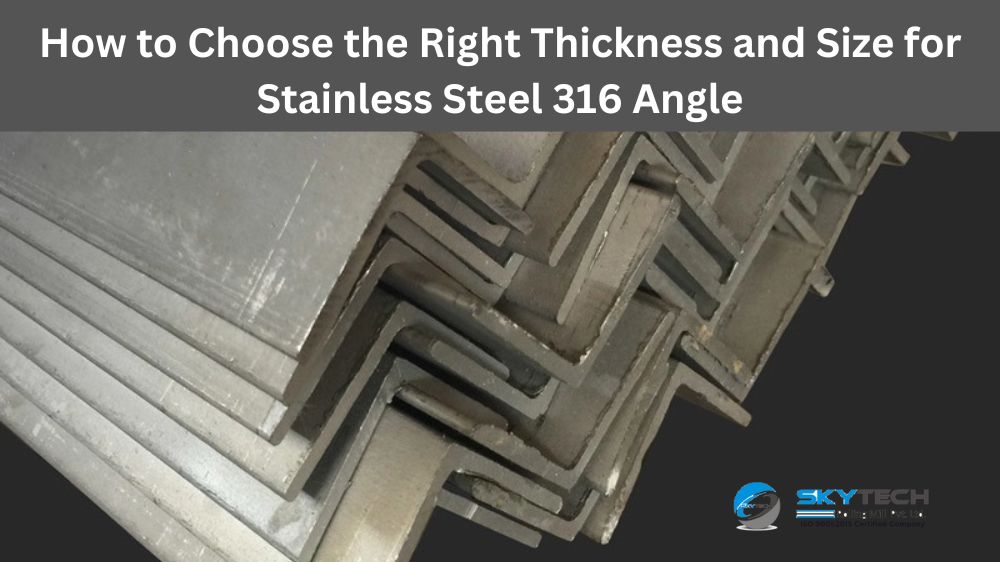
If you’re working with stainless steel 316 angle, then you know that choosing the right thickness and size can affect the longevity and durability of your project. You want to ensure that your chosen angle is strong enough to withstand the weight and pressure it will bear. This guide will help you navigate the various thicknesses and sizes of stainless steel 316 angles to help you make an informed choice.
Factors to Consider When Choosing Angle Thickness
Choosing the right thickness and size for stainless steel 316 angle depends on several factors. The first factor to consider is the weight of the material being supported by the angle. Heavier materials require a thicker angle to hold up under heavy loads. The second factor is corrosion resistance since thinner angles may be more prone to corrosion due to their smaller surface area than thicker angles. Lastly, the budget should be considered when selecting an angle thickness and size since heavier gauges will likely require a higher purchase price than lighter gauges while offering greater support and protection against corrosive elements.
Choosing the Right Size for Your Angle
Consider a few factors when choosing the right size and thickness for your stainless steel 316 angle. First, think about the application the angle will be used in. For exterior applications, thicker angles are often preferred as they are more durable and corrosion-resistant. Additionally, account for any weight or wind loading that may affect it; lighter materials may not be able to withstand extreme forces. Lastly, consider any aesthetic requirements when selecting an angle thickness – from a thin line to a bold statement piece. With these factors in mind, you can choose the right size and thickness of stainless steel 316 angle for your needs!
Stainless Steel 316 Angle Sizes and Thicknesses
The thickness and size of the stainless steel 316 angle you choose depend on what application it is being used for. To determine the best fit, consider factors like corrosion resistance, weight-load needs, structural stability and aesthetics. Generally, thicker materials are better suited for heavier loads when selecting a thickness, while thinner ones are great where more flexibility is needed. Size selection also affects how much load it can bear – shorter angles can be stronger than longer ones in certain applications. Make sure to select the right size and thickness for your specific application!
How to Calculate the Load Capacity of Your Angle
Choosing the right size and thickness of a stainless steel 316 angle is important for ensuring that it can carry any loads that may be added to it. To calculate the load capacity of your angle, you must first determine its maximum allowable bending stress. This is done by multiplying its Section Modulus (W) by the allowable stress for stainless steel 316, typically 20,000 psi. Once you have this value, divide it by 2 to get the tension value at each end of your angle. Then, use this value and the length and thickness of your material to calculate the bending moment using a simple equation like M = P * L/2, where P represents your applied force in life, and L represents the length of the beam in inches. Finally, use this moment with section modulus again to calculate the ultimate load capacity for your angle.
Why Stainless Steel 316 Is the Best Choice
Stainless steel 316 angles is the best choice for strength and durability applications. It is corrosion-resistant and can withstand high temperatures and pressures. It is also easy to clean and maintain, making it a cost-effective choice for your project.
Conclusion:
In conclusion, choosing the right thickness and size for stainless steel 316 angles are essential to ensure the longevity and durability of your project. Consider factors such as the weight and pressure it will bear, the attachment points, and the distance between them. Stainless steel 316 angles is the best choice because of its strength, durability, and corrosion resistance. If you need help with the size and thickness, consult a professional.